
FLOORING
Important points to note when installing flooring and solid wood flooring
Due to the nature of natural wood, solid wood flooring may warp, crack, or twist depending on the storage conditions and usage environment. In addition, moisture in the air and humidity from under the floor may cause the floor to expand or contract, which may cause inconvenience depending on the installation conditions.
For the comfort of our clients, please be sure to read these precautions carefully for storage, installation, and maintenance, and understand the characteristics of solid wood before installing.
If you have any questions about the product or installation, please contact us or your dealer.
Storage precautions
Avoid storing in places where it may get wet, in humid places, or in direct sunlight.
For storage, place rings of the same height on a level surface and store horizontally.
Shrink-wrapped products will discolor when exposed to ultraviolet rays, so be sure to cover them with plastic sheeting or something similar.
Important points to note when installing flooring and solid wood flooring
Due to the nature of natural wood, solid wood flooring may warp, crack, or twist depending on the storage conditions and usage environment. In addition, moisture in the air and humidity from under the floor may cause the floor to expand or contract, which may cause inconvenience depending on the installation conditions.
For the comfort of our clients, please be sure to read these precautions carefully for storage, installation, and maintenance, and understand the characteristics of solid wood before installing.
If you have any questions about the product or installation, please contact us or your dealer.
Storage precautions
- Avoid storing in places where it may get wet, in humid places, or in direct sunlight.
- For storage, place rings of the same height on a level surface and store horizontally.
- Shrink-wrapped products will discolor when exposed to ultraviolet rays, so be sure to cover them with plastic sheeting or something similar.
Check before construction
- Due to the nature of natural hardwood, be sure to leave it unpacked to prevent expansion and contraction and allow it to fully acclimate to the environment at the construction site.
- Please note that due to the nature of coniferous wood, if left for an extended period of time after unpacking, it may warp, crack, twist, etc. depending on the environment at the construction site.
- This product is for interior use only; please refrain from using it for exterior purposes.
- For underfloor heating, please use flooring recommended by our company.
- Please check whether the ventilation holes are sufficient. If the ventilation under the floor is insufficient, problems such as "moving", "jutting up", and "floor creaking" may occur after construction.
- Please carry out the work after installing sashes and other openings, to prevent the base material and flooring materials after construction from getting wet due to rain, etc.
Base construction
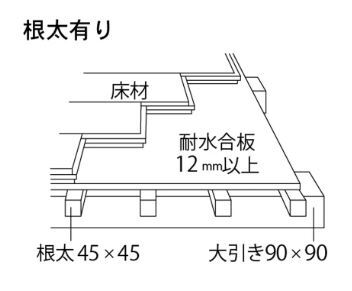
With joists
|
 |
|
|
|
|
|
No joists
- For the joists, use dried lumber that is 105mm square or larger and finish it smooth with a planer.
- The spacing between the joists should be 3 shaku (909 mm) and the structure should be level when installed.
- Be sure to use waterproof plywood that is 24mm or thicker.
- If there is a lot of moisture under the floorboards, install a moisture-proof sheet that is 0.1 mm or more thick between the floor joists and the disposable plywood, or caulk and tape the joints to prevent moisture from getting in from under the floorboards.
Moisture-proofing
To prevent the flooring from expanding, dry the concrete under the floor thoroughly until the moisture content is below 10% and keep it well ventilated. Also, be sure to place a moisture-proof sheet under the waterproof plywood. Also, make sure the plywood under the floor is not damp.